
Niche Fragrance Brands and OEM: The Step-by-Step Path to a Men's Line
Niche fragrance brands and OEM manufacturing fit together well, but only when the brand accepts the economics of small volume before it starts. A niche line sells at a price that can carry a richer formula, and it sells in quantities that make tooling and component minimums the real constraint. The step-by-step path is therefore not a shorter version of a mass-market project; it is the same process with different decisions in the middle. Get the pack and the reorder plan right and the rest follows in a predictable order.
Key takeaways
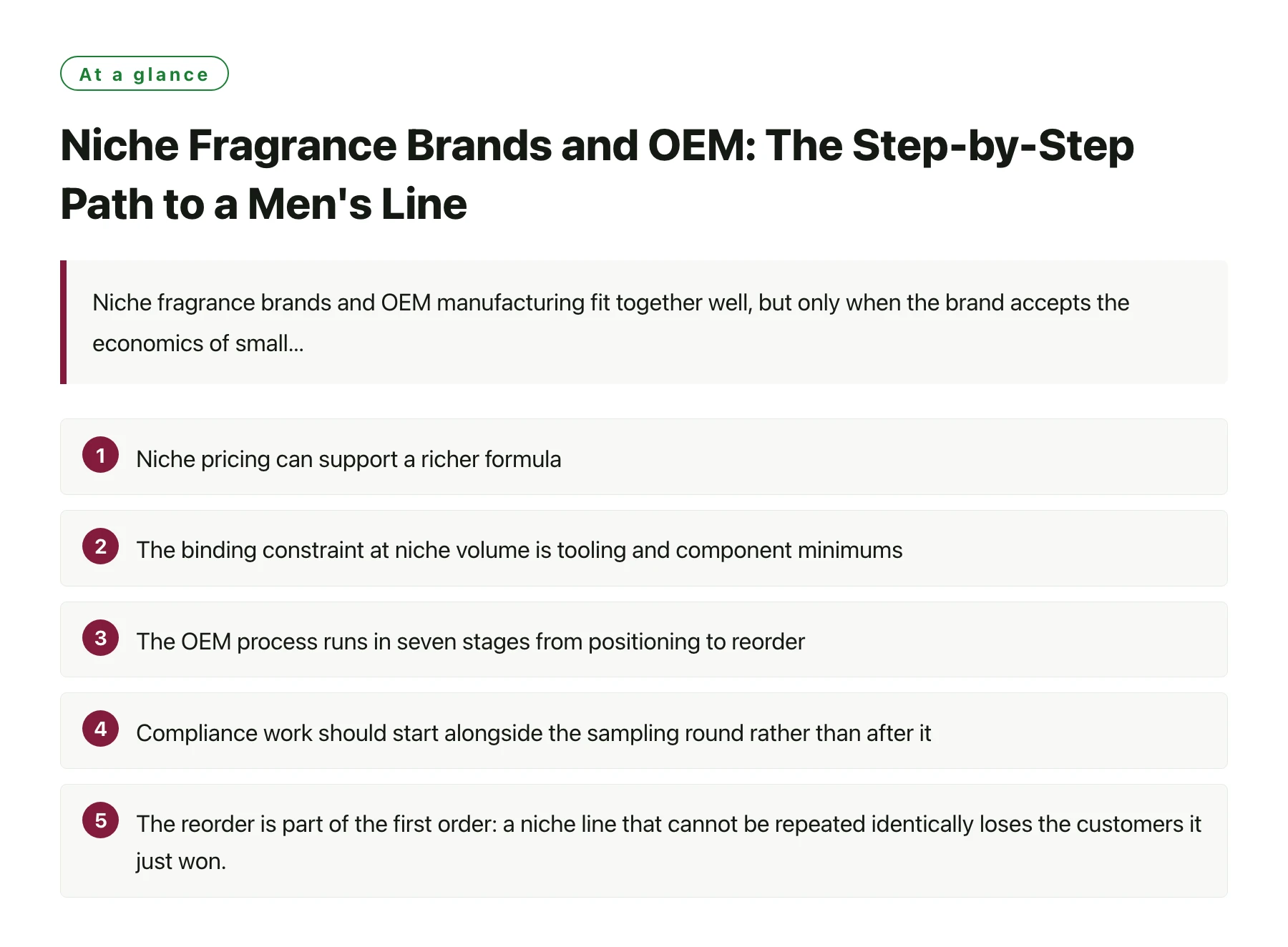
- Niche pricing can support a richer formula, so the fragrance load is usually not where a niche brand should economise.
- The binding constraint at niche volume is tooling and component minimums, which is why stock or semi-custom packs often make a better first run than a bespoke bottle.
- The OEM process runs in seven stages from positioning to reorder, and each stage has one approval that belongs to the brand.
- Compliance work should start alongside the sampling round rather than after it, because the documentation takes longer than the perfume.
- The reorder is part of the first order: a niche line that cannot be repeated identically loses the customers it just won.
A niche brand usually arrives at an OEM conversation with two assumptions: that small volume means compromise on quality, and that a distinctive bottle is the fastest way to look established. Both assumptions cause problems. The first is wrong — low volume constrains tooling, not necessarily the juice. The second is expensive precisely because low volume is where tooling hurts most.
This article walks through the process in the order it actually runs, with the decision that belongs to the brand at each stage.
The seven stages, and what the brand decides at each
- Positioning and price architectureDecide the retail price, the channel and the size. This fixes the unit cost ceiling, which is the number every later decision has to respect.
- Brief and development routeChoose between adapting a library accord and developing a direction for the house. At niche volume the development fee is spread over fewer units, so the choice matters more than it does at scale.
- Sampling roundsApprove a scent on blotter and then in the finished base, and retain a sealed reference. Two or three rounds is typical; the brief decides whether it is two or four.
- Pack and closure selectionPick the bottle, cap and carton within the component minimums the units allow, and settle the decoration method before tooling is discussed.
- Documentation and complianceCollect the safety and ingredient records, confirm the restriction status of the formula, and prepare the label text that follows from both.
- Production and releaseBulk is batched, filled, decorated and packed against the retained reference, with the batch record released as part of the delivery.
- Reorder and continuityConfirm how the same formula is repeated, how long the reference is kept, and what notice a component change would require.
Why niche economics change the OEM conversation
Two numbers separate a niche project from a volume project: the units per order and the price per unit. The first decides which components are available at all, and the second decides how much of the cost structure the brand can absorb.
Reading them together produces a useful rule. Spend on the juice and the perfumery time, because that is what the customer pays a niche price for, and standardise the component set, because that is what low volume punishes.
Low volume is a tooling problem before it is a juice problem
A bespoke bottle requires a mould, and the mould cost is amortised over the first run, which at niche volumes can add more to the unit price than any formula change. A stock or semi-custom bottle with a distinctive decoration often delivers the same shelf presence without the amortisation. Where a bespoke mould is genuinely wanted, it is worth asking what the component minimum is for the bottle, the pump and the carton, because the answer for each may differ.
The same logic applies to the closure. A crimped pump and a screw cap do not just look different; they carry different component minimums and different leak-testing requirements, and the choice can move the real entry volume for the project.
The formula is where the niche price is earned
Because a niche line sells fewer units at a higher price, the fragrance load and the quality of the materials are the parts a customer can actually perceive. A higher load also uses more of the restricted-material allowance for each material in the formula, so the ceiling on a direction is often set by its most restricted component rather than by taste [1]. Discussing that early with the development team is simpler than discovering it after a formula has been approved.
Public aroma material references are a useful preparation tool here, because they describe how a material is normally characterised and where it appears in published literature [2]. They are not a substitute for the perfumer's judgement, but they make the vocabulary of a sampling discussion much easier to follow.
Where niche brands lose the plot
Three failure patterns show up repeatedly in small-volume fragrance projects, and all three are visible in the first month if anyone looks for them.
Over-specifying the pack on the first run
A bespoke mould, a custom cap and a coated bottle in the same first order multiplies setup costs that cannot yet be amortised. The usual result is a line that has to be priced above its intended shelf position, or a formula diluted to rescue the margin. Choosing one element to customise and standardising the rest keeps the project inside its ceiling.
Launching too many scents at once
A niche house is not defined by the size of its launch range. Three scents at niche volume triple the sampling rounds, the component orders and the inventory, while each scent sells a third as fast. One well-built launch scent, with a second added once the first has a reorder history, is the cheaper route and the better story.
Not planning the reorder
The failure that hurts most is a scent that cannot be repeated. If the formula was never documented as a reference, if the component was a one-off purchase, or if the retained standard was not kept, the second run will not match the first. Niche customers are unusually sensitive to this because they buy the specific scent, not the category. When the development and filling stages sit with one partner, as they do with niche fragrance brands served by an established OEM, the reorder plan can be settled during development instead of being reconstructed afterwards.
A useful test before signing anything: ask the manufacturer to describe the second order. Not the price, the process — how the formula is retrieved, how the reference is compared, how the component is re-sourced and how quickly. A partner that treats a repeat order as a normal event, rather than an exception to negotiate, is the one that suits a niche brand. It is also a question that a a contract manufacturer for perfume brands with an established client base can answer immediately, because repeat production is the daily work rather than a special case.
Sources
- IFRA Standards Library (International Fragrance Association) —— The IFRA Standards Library lists the restrictions the fragrance industry applies to individual fragrance ingredients, based on safety assessments; it is the reference point for compliant fragrance formulation.
- The Good Scents Company —— A reference database of aroma materials with odour descriptions, CAS numbers and typical usage information.
Frequently asked questions
Can a niche brand use an OEM factory at low volume?
Yes. The constraint is usually component minimums and tooling rather than the fragrance itself. Choosing a stock or semi-custom pack for the first run is the standard way to keep a niche launch within a workable entry volume.
How many sampling rounds does a niche men's line need?
Two or three is typical when the brief is specific about occasion, wear time and market. Rounds increase when the brief describes a feeling rather than a target, or when several decision-makers give conflicting feedback.
Is a bespoke bottle worth it on a first order?
Rarely on the first order at niche volume, because the mould cost is amortised over fewer units. A standard heavy bottle with one strong decoration step usually delivers comparable presence at a fraction of the entry cost.
What documentation should a niche brand collect?
The safety and ingredient records behind the label, the restriction status of the formula, the retained reference standard, and the batch record for the shipment. Collect them as the project runs rather than at the end.
How do I make sure the second order matches the first?
Ask how the formula and the retained reference are stored, how long they are kept, and how the component is re-sourced. Settle that during development, because it cannot be fixed retroactively.
Leve o atlas inteiro no celular — GPX, água, abrigo e condição real.
Baixe o planejador de rotas grátis e monte sua próxima travessia com dados verificados por 64 colaboradores de campo.
Baixar o planejador de rotas grátis